
PSAA process
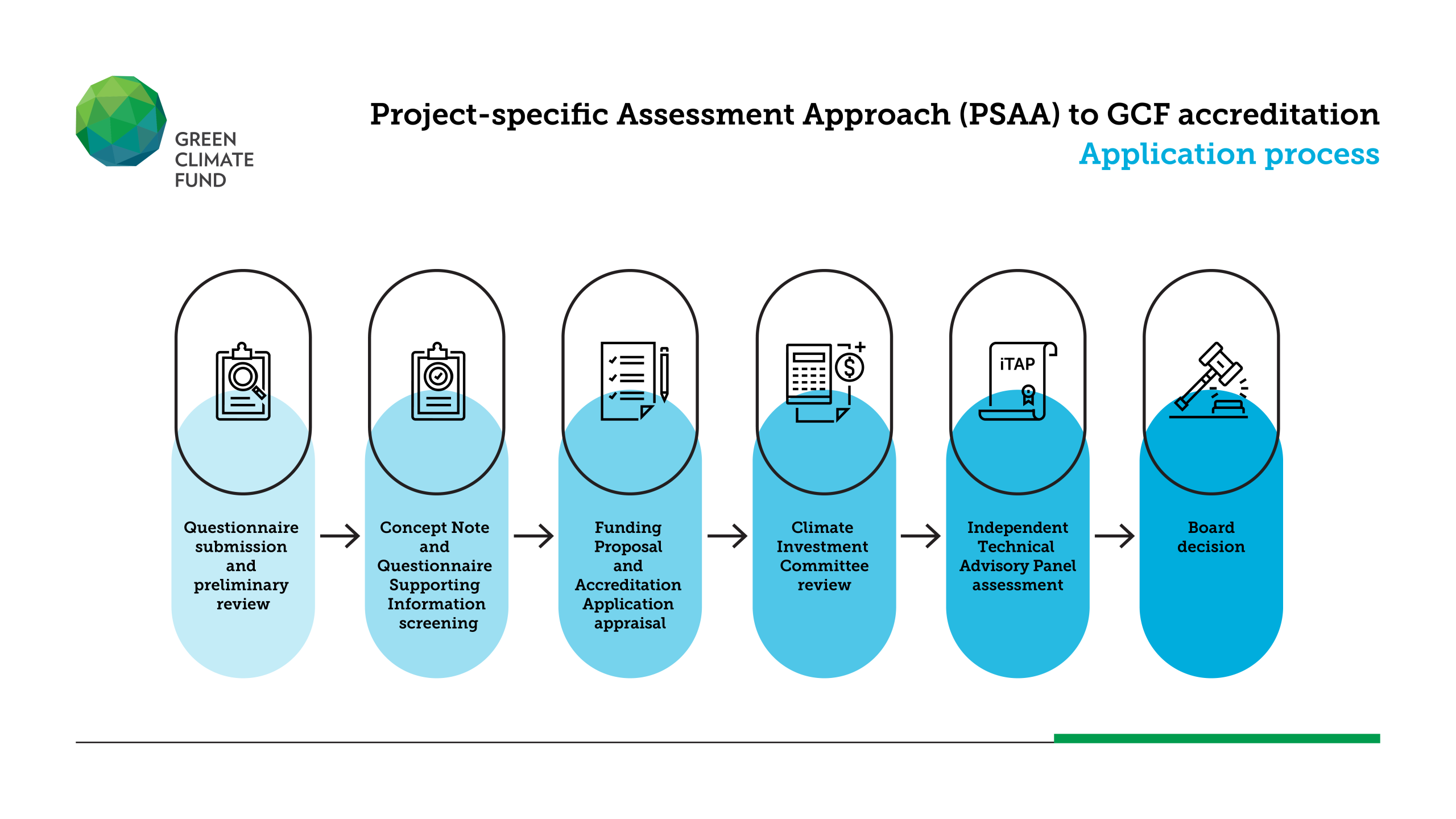
Process
- An entity submits a PSAA questionnaire for a preliminary review, including:
- Project/Programme summary
- Pitchbook
- Evidence of country ownership & stakeholder engagement
- If the entity passes the preliminary PSAA review, the entity will be granted access to the GCF Partner Portal (GPP).
- If granted access, the entity is invited to submit a concept note and questionnaire supporting information to the GPP.
- If access is not granted, the entity receives regrets or an invitation to revise and resubmit the questionnaire.
- The entity submits the Concept Note and PSAA Questionnaire Supporting Information to the GCF Partner Portal (GPP).
- The GCF Secretariat verifies that the appropriate documents have been submitted. Documents include:
- PSAA questionnaire
- PSAA supporting documents (legal status, financial management, track record)
- Concept note
The project team conducts an initial review of the Concept note (CN), PSAA questionnaire supporting documents to assess whether the quality is sufficient for further review.
- The Secretariat screens the CN according to its procedures, along with the PSAA questionnaire supporting information, with a focus on the following questions:
- Does this proposed project/programme have the potential to fully meet GCF investment criteria?
- Does this entity have the potential to contribute to the mandate of GCF?
- Does this proposed project/programme or partnership pose any reputational risks for GCF?
- Does this entity have the potential to meet GCF’s fiduciary standards and principles in the context of this project/programme?
- Does this entity have the potential to manage relevant environmental and social (ESS) risks (including sexual exploitation, abuse and harassment) and gender risks in line with GCF policies and standards and the scaled risk-based approach in the context of this project/programme?
The Secretariat decides whether the proposal is aligned with GCF investment criteria and PSAA eligibility criteria and merits further development (including Project Preparation Facility - PPF if requested), return the proposal to the entity for revision and resubmission, or not recommend the proposal/entity partnership. In the case where Project Preparation Facility (PPF) resources will be requested, the NDA is required to provide a no-objection letter before the PPF application is approved.
-
Following CN confirmation, the Secretariat sends the entity a PSAA Accreditation Application that is customized to the type of project, including specialized fiduciary standards required, and the ESS category. The Secretariat will provide guidance on the estimated total fees for the PSAA Application based on the size of project and any applicable specialized fiduciary criteria. Fees are only payable after the Secretariat recommends the proposed project/programme for iTAP consideration.
Note: The entity will submit the full funding proposal package and a PSAA accreditation application via the GPP.
- Following receipt of the PSAA accreditation application and FP package, the Secretariat conducts parallel technical reviews.
- The PSAA accreditation application and funding proposal are sent to a PSAA review firm contracted by the Secretariat to conduct an institutional capacity and project track record assessment of the entity.
- If the overall capacity rating is high or medium, the accreditation assessment and funding proposal are presented to the Secretariat’s Climate Investment Committee (CIC). This submission follows technical clearance from the GCF project team and receipt of all Non-objection letters (NOLs).
- If the PSAA capacity rating is low, NDAs may request Readiness and Preparatory Support Programme (RPSP) resources to address the gaps identified.
- The CIC decides whether to endorse the proposal for submission to the Independent Technical Advisory Panel (iTAP) for assessment and the Board for approval.
- Following CIC endorsement, the entity pays the PSAA accreditation fees before proceeding to the iTAP assessment. Fees for the PSAA application shall be calculated at the ratio of 80 per cent of the fees payable under the Policy on fees for accreditation.
- Accreditation fees are based on the total projected costs of the proposed climate project or programme at the time of the application. There are four categories which refer to the maximum total projected, irrespective of the portion that is funded by GCF for an individual project or programme.
- Micro (up to and including USD 10 million): USD 800 for the basic fiduciary standards and USD 400 for each specialised fiduciary standard;
- Small (above USD 10 million and up to and including 50 million): USD 4,000 for the basic fiduciary standards and USD 800 for each specialised fiduciary standard;
- Medium (above USD 50 million and up to and including USD 250 million): USD 8,000 for basic fiduciary standards and USD 2,400 for each specialised fiduciary standard
- Large (above USD 250 million): USD 20,000 for basic fiduciary standards and USD 5,600 for each specialised fiduciary standard
Note: To move to CIC stage, the NOL(s) must be submitted.
-
The independent technical advisory panel (iTAP) conducts technical assessments of funding proposals and provides its analysis and recommendations to the Board. The independent TAP conducts the technical assessments of the performance of proposed projects/programmes against activity-specific criteria, as defined in the GCF initial investment framework.
The iTAP assessment, with conditions if applicable, and the responses of the AE are included in the funding proposal package that is presented to the Board.
- After iTAP endorsement of the funding proposal, the PSAA application and FP will be sent to the Board for approval.
- Following Board approval, the entity and GCF will enter into a PSAA legal agreement. This is a hybrid of the Accreditation Master Agreement (AMA) and Funding Activity Agreement (FAA), which will reflect relevant reporting requirements under GCF’s monitoring and accountability framework.